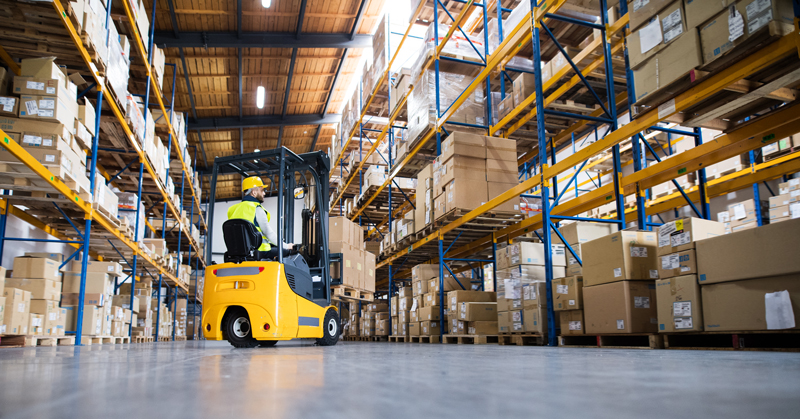
National Forklift Safety Day, why are we talking about it? Approximately, 1,300 UK employees annually are seriously injured due to forklift accidents. This is not acceptable, and more alarming of those injured or killed, 57% aren’t forklift operators, but pedestrians instead.
Therefore, the key message to take from the National Forklift Safety Day 2020 (9th June) is managements responsibility for segregating pedestrians from Materials Handling equipment (i.e. Forklifts). Throughout this article, we address the issues at hand and how lives can start being saved in the workplace.
Previously, the focus was on management being responsible for ensuring operator restraints were being used (i.e. seat belts). This is still valid today, and the key messages from previous years should not be forgotten about.
National Forklift Safety Day Contents:
- How segregation saves lives
- You will be prosecuted
- Carrying out a risk assessment
- What to consider for your site layout
- Smart systems
- Training
- Summary
1. How segregation saves lives
The easiest way to protect pedestrians from forklifts is correct segregation. Use of barriers, markings on the floor, no pedestrian zones and/or assistance systems.
We spoke to Adam Smith the Managing Director of AITT and Chairman of the ABA about his thoughts on how segregation between pedestrians and forklifts can save lives:
“Many forklift trucks are operated in dense areas of pedestrian activity, and figures tell us that 57% of those injured by lift trucks are pedestrians. Therefore, to safely operate a forklift you must be aware of your surroundings at all times. With correct pedestrian segregation, you can help reduce the risk of collisions and ultimately save lives, but we must remember that safety starts with the operator of the forklift. We must ensure operators are adequately trained, along with supplying them with suitable work equipment and a safe system of work. This will ensure improved safety in the workplace.
Adam Smith the Managing Director of AITT and Chairman of the ABA”
2. You will be prosecuted
The Health and Safety Executive (HSE), do not shy away from prosecuting negligent companies and issuing penalties.
In February 2020, UK Mail were fined £400,00 after admitted breaching the Health and Safety at Work Act 1974. This was after two employees were injured by forklifts on two separate incidents. Both employees were not forklift operators and due to having no effective pedestrian and vehicle segregation, the incidents were caused.
One of the workers was an operations administrator who was sorting returned parcels and the other a warehouse operative who was inspecting a parcel. If there were adequate pedestrian areas for employees to remain clear from forklifts, these incidents would have never happened. Both employees suffered life-changing injuries, including nerve damage and a bleed to the brain.
HSE inspector Roxanne Barker said:
“The company failed to properly manage workplace transport in the warehouse area. The systems of work in place were not safe. Adequate control measures were not identified or implemented, and effective segregation was not in place, nor, even adequate workways. The incident heightens awareness of the need to properly assess and control the risks to employees from workplace traffic movements and a reminder that these types of failures can lead to life-changing injuries.”
For more information, visit the HSE press release.
This is not the only recent case. The following recent press releases from the HSE were due to segregation not being in place:
Every single case above was due to segregation not being present or sufficient.
3. Carrying out a Risk Assessment
The Management of Health and Safety at Work Regulations 1999 requires employers to carry out risk assessments to protect employees and others. This isn’t a tick box exercise, this is about keeping employees safe at work and giving them the right to return home safely.
If you’re new to risk assessment or haven’t done one for a while, these are the 5 steps that must be followed for all risk assessments, not just forklift operations:
- Identify the hazards, think of all the scenarios, and don’t miss any hazards with the thinking of ‘that won’t happen’. If it CAN happen, then it is a POTENTIAL HAZARD.
- Determine who might be harmed and how. Is it employees, is it visitors?
- Evaluate the risks and what precautions are necessary. What can you do to reduce that risk?
- Ensure that all findings are recorded and implemented in a timely manner. It is a legal requirement that all workplaces with 5 or more employees, to have a physical record of all risk assessments.
- Regular review the risk assessment and update if needed.
“It is crucial that businesses that operate any type of MHE consider what impact that type of equipment may have on their work environment. It is important that businesses carry out a thorough risk assessment which starts at the equipment selection stage. Making sure you get the equipment that is suitable to the environment and is designed to do the task required will not only be safer but may reduce your costs. As part of this process, there are a few simple measures which can be taken to help you have a safer operation.
Various Health and Safety regulations such as “The Provision and Use of Work Equipment Regulations 1998” details several requirements that employers should apply. Some of these include ensuring that work equipment is suitable for the purpose for which it is used, putting in measures to maintain and inspect the equipment at suitable intervals and providing adequate training in the use, both for operators and supervisors. Considerations should take place with regards to the workplace transport risks such as how you may reduce the pedestrian and MHE interaction.
Richard Holtom – Director of Prohas Ltd Health and Safety Consultancy“
When it comes to forklift safety, we’re encouraging all workplaces to conduct a risk assessment around segregation. If you’re going to take anything from the National Forklift Safety Day 2020, this should be it. Examples of what questions to be asking when doing a risk assessment:
- Where does a forklift need to be operating?
- Where will pedestrians be walking in the workplace?
- Where could a truck lose stability.
- If using a truck that lifts employees up, are they at risk of falling?
- Can a worker be crushed by a moving forklift?
- Are there any blind spots where a forklift is operating?
- Does the forklift have a working horn, lights etc?
- Is there a potential for an unsafe load or loading area?
- Could the vision of the forklift operator be affected by oversized loads?
- Could a load extend outwards or sideward beyond the forks?
When doing a risk assessment, it must be specific to the workplace and site. Don’t just use a generic risk assessment for multiple sites or download a pre-done risk assessment from the internet. This isn’t going to be relevant to your workplace. Every workplace is different and each have different risks.
The good news is that there are many ways to create a safe working environment and protecting pedestrians from forklifts. It doesn’t have to cost a fortune and depending on the size of your workplace, will depend on what you choose to implement for segregation of pedestrians and forklifts.
4. What to consider for your site layout
When it comes to planning your site layout, this is a big opportunity to consider how you can ensure that forklifts and pedestrians aren’t at risk of colliding with each other. Taking time to either re-plan your current site layout or to plan a new site, comes hand in hand with your risk assessment.
- Where will pedestrians be walking and will it be safe for them to walk there?
- Which areas could potentially have a forklift in operation?
- Will you be clearly marking the floor as a forklift area such as using markings on the ground?
- Will you be using barriers to stop pedestrians going into areas where forklifts are operating?
- Have you got adequate lighting in all the locations?
- Is signage present or going to be to show clearly that this is a pedestrian-only area or forklifts are in operation.
- Do you need to have traffic controls in place such as mirrors for a bling spot, pedestrian crossing points etc?
- Will you be operating a one-way system?
- Are the forklifts fitted with smart systems?
- How will you make sure staff are aware of all the systems and procedures that you’ve put in place?
5. Smart Systems
Technology can also play its part in keeping pedestrians safe. Smart fencing systems can be implemented alongside other measures previously mentioned. Some of the systems that could be used include:
- Safety lamps which project warning symbols from the forklift. These can be used to people to see what safe distance they need to be away and can be set to a pre-determined distance, based off of your risk assessment.
- Visual and audible warnings can be fitted to forklifts. For example, an audible that sounds when a forklift is reversing, or warning sounds that can be initiated when a forklift is approaching a blind corner.
- Object-detection systems, similar to what you can find in cars these days. These will provide a warning when getting close to potential hazards.
- Speed restrictors to ensure that forklifts don’t go above a certain speed. You can even go further than this and have speed restrictors trigger in certain areas of a site.
6. Training
You may have heard the term forklift license before. This doesn’t exist. Instead, training is a certification to prove competency and is a requirement from the HSE.
The first training you need to ensure you have in place is forklift operator training. The key point to remember is that just because someone has been trained on one type of equipment, this does not mean they are trained on all types of material handling equipment. For example, if an operator is trained on a counterbalance forklift, they will also need separate training for any other forklifts they operate such as a reach truck.
The different categories of training for forklift operators are:
- Novice – An operator who hasn’t used a forklift before or has done for less than 6 months with no training before.
- Experienced – An operator has been using the forklift for at least 6 months but has never received formal training.
- Refresher – The operator has been trained before in the last 3 to 5 years.
- Conversion – The operator has been trained on a different type of forklift before but wishes to now be able to operate a different one.
Additional to forklift operator training, it is important that supervisors are also aware of how a forklift operates and its safe practices. Otherwise, how can they be expected to supervise forklift operators correctly? This type of training could also be extended out into awareness courses for non-forklift operators to take.
7. Summary
As you can see, too many serious and sometimes fatal accidents are happening in the workplace when forklifts are involved. This doesn’t mean forklifts are the issue, it is usually the risk assessment and segregation between pedestrians and forklifts.
Let’s not let this year’s National Forklift Safety Day message be forgotten about and start to implement changes in the workplace.
In the meantime, if you do wish to book any forklift training, feel free to drop me a message michael@trainow.co.uk or simply call us on 0113 293 9911.